The parts of a club are the shaft, the grip and the head. The clubhead design and loft will determine accuracy and trajectory. However, of all parts of the golf club that affect playability, the shaft is perhaps the most underappreciated.
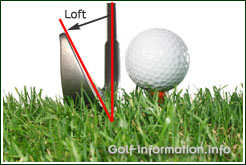
For some shots with a particularly high trajectory such as pitches, the club actually hits the ball in a downward motion, and with most other shots the motion is more or less horizontal. Typically, the greater the loft angle, the higher and shorter the resulting ball trajectory with greater spin. Reversely, a smaller club loft angle produces a lower trajectory and spin.
3. Shaft Flex and Shaft Torque
Shaft properties such as shaft flex and shaft torque, shaft length and weight, influence playability. This is especially true for graphite shafts.
At any given swing speed, the stiffer the shaft, the more accurate the shot, but over a comparatively shorter distance. Reversely, a more flexible shaft will translate in a less controlled shot, but over a longer distance. For more info on shaft flex, see: shaft flex>>
A high torque shafts are less forgiving of off-center shots as they will allow the head to twist, causing pulls and pushes. Low-torque shafts resist twisting and are more forgiving, but tend to be stiffer and thus require more power for a comparable distance.
Golf clubs are designed with the face having differing lofts (the angle between a vertical plane and the clubface when the club is at rest). Loft is the major determinate of trajectory. Perhaps with the exception of tee shots, it is loft that makes a golf ball leave the ground, not an upward direction of swing.
How To Select Golf Clubs: Choosing the Right Golf Irons
by Quick Easy Guides More information:
The Search for the Perfect Golf Club
by Tom W. Wishon, Tom Grundner An extremely well-written book on golf equipment technology for the everyday golfer. More information:
Further Reading: Newton on the Tee by John Zumerchik. New York: Simon & Schuster 2002.
The ruling authorities of golf, the Royal and Ancient Golf Club of St Andrews (R&A) and the United States Golf Association (USGA) reserve the right to define what shapes and physical characteristics of clubs are permissible in tournament play.
Several recently developed woods have a marked "spring-like effect" (i.e. a strong rebound of the ball from the clubface) resulting in very high ball speeds and great lengths of tee shots. Current USGA and R&A regulations differ with respect to acceptable limits of the "spring-like effect". Therefore, a few club types may not be played in tournament or professional play under USGA jurisdiction, but are allowed elsewhere.
Golf is played with a set of different golf clubs. There are five major categories of clubs, known as woods, hybrids, irons, wedges and putters. As wedges resemble irons they are sometimes counted among these. For the typical number of golf clubs in a set, see also: the basic set of golf clubs>>
Wilson, Callaway, Titleist, Adams, King Cobra, Yonex, Ping, Taylor Made, Mizuno, and Spaulding are all excellent name brand golf clubs. As a beginning or even a professional golfer, trying to decide which set of golf clubs to purchase, however, may often feel like taking a shot in the dark. Read more about how to choose the best golf clubs fit for your game >>
The lob wedge can add a new dimension and versatility to anyone's short game. Learn to pick the right wedge for best results. Read more about choosing the right lob wedge for your game >>
Shaft flex, material and shaft weight, bend point and torque are all factors that combine to impact ball trajectory, solidness of feel, consistency of hit, directional control and distance a golfer can hit a golf ball. Unfortunately, there are no standards between manufacturers of golf shafts for critical features of a golf shaft such as flex so that a Regular flex shaft from one manufacturer could be a Stiff flex from another manufacturer. By having your golf clubs, and particularly your golf shaft, custom fit are one way to ensure that all of the key variables are tuned to allow you hit the ball consistently. Read more>>
The hottest trend is to replace some of the long irons by hybrid utility clubs. In fact, hybrid utility can do a lot more are and replace nearly any club in your golf bag. Read more about hybrid utility clubs >>
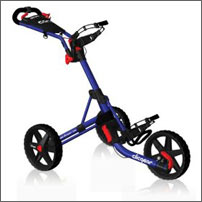
Clicgear 2.0 Push Golf Cart
The most compact push cart in the industry.
Folds to 24" x 15" x 13" More information:
Our Favorites
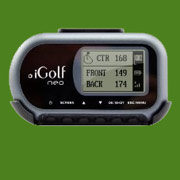
iGolf neo Pocketsize Golf GPS
A handy golf-course aid that automatically displays the distances to key points on any golf course in the world. More information: